
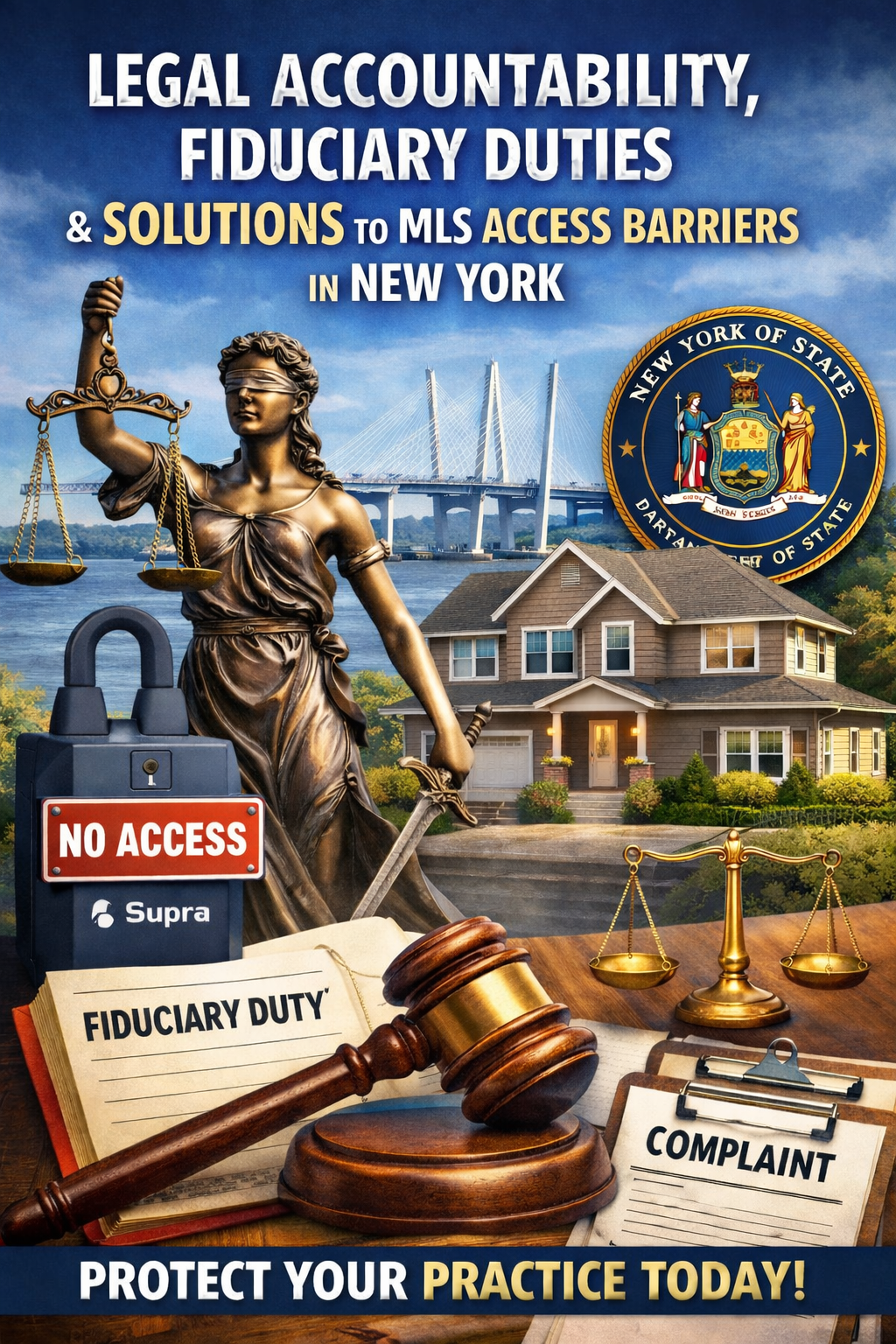
Ending MLS Access Barriers: Legal Accountability, Fiduciary Duties, and the Path Forward in Westchester County, NY
The real estate industry in New York, particularly in Westchester County, is facing a growing challenge, agents refusing property access to licensed professionals who are not members of a specific Multiple Listing Service (MLS). This practice raises serious legal, ethical, and fiduciary concerns. At Manfred Real Estate Learning Center, we believe in empowering professionals with the knowledge and tools to uphold lawful cooperation, client loyalty, and fair housing principles across the state.
In the dynamic real estate environment of Westchester County, NY, cooperation among licensed agents is essential for a transparent and competitive marketplace. However, when MLS membership becomes a gatekeeping mechanism, it undermines both professional integrity and consumer trust. The issue is not just operational, it's a matter of legal accountability and fiduciary duty. Every licensed broker and salesperson in New York must understand that their authority to transact comes from the state, not from private MLS organizations.
At Manfred Real Estate Learning Center, we are committed to helping real estate professionals navigate these complex issues. Through comprehensive education, continuing education courses, and compliance training, our programs equip you with the legal and ethical knowledge necessary to protect your clients and your license. The path forward requires awareness, accountability, and decisive action to ensure that every licensed professional in New York can operate without artificial barriers.
By addressing MLS access restrictions head-on, we can restore fairness and cooperation to the marketplace. The benefits of understanding and acting on this issue include:
- Legal Protection: Avoid regulatory penalties and maintain compliance with New York State Department of State (NYDOS) standards.
- Enhanced Client Service: Broaden property exposure and ensure clients receive the best possible representation.
- Ethical Integrity: Uphold the REALTOR® Code of Ethics and strengthen professional trust.
- Fair Housing Compliance: Prevent disparate impact and promote equal opportunity in housing access.
What is an MLS Access Barrier?
MLS access barriers occur when agents or brokerages deny property showings to licensed professionals who are not members of a specific MLS, often citing lockbox restrictions or internal policies.
These barriers are more than inconveniences, they represent potential violations of state licensing law, fiduciary duty, and fair housing principles. In Westchester County, where multiple MLS systems overlap, this issue has become increasingly visible. Licensed agents are being denied access to properties they are legally entitled to show, simply because they do not pay dues to a specific MLS. This practice undermines the cooperative spirit that defines New York real estate.
Key Takeaways:
- MLS membership is not a legal prerequisite for brokerage activity in New York.
- Refusing access based on non-membership may violate ethical and fiduciary obligations.
- Technology like Supra and SentriLock should enhance, not restrict, professional cooperation.
- Regulatory complaints to the NYS Department of State can enforce accountability.
MLS Membership Is Not a Legal Prerequisite for Brokerage in New York
In New York, a real estate license issued by the Department of State authorizes professionals to transact anywhere in the state under proper supervision. This authority is derived from state law, not from MLS membership.
MLS systems are private organizations that provide valuable tools, data aggregation, and compensation frameworks. However, they are not legal gatekeepers. A licensed broker or salesperson can represent buyers, submit offers, and show properties without belonging to any MLS. When listing agents deny access solely because a cooperating broker is not an MLS member, they elevate private association rules above state law a practice that is neither legally grounded nor ethically defensible.
At Manfred Real Estate Learning Center, we emphasize the importance of understanding the distinction between state licensure and private membership. Our continuing education programs teach agents how to navigate these boundaries confidently and lawfully.
Article 3 of the NAR Code of Ethics: Cooperation Is Mandatory
Article 3 of the National Association of REALTORS® Code of Ethics mandates cooperation among brokers except when it is not in the client's best interest.
Refusing to cooperate with another licensed broker simply because they are not part of a specific MLS does not serve the client's best interest. Instead, it restricts property exposure, narrows market participation, and may even reduce the seller's opportunity for competitive offers. Cooperation is not optional, it is a professional obligation rooted in client advocacy.
At Manfred Real Estate Learning Center, we help agents understand how ethical standards align with fiduciary duties. Our training emphasizes that cooperation enhances client outcomes and strengthens the integrity of the marketplace.
- Cooperation ensures maximum property exposure.
- Ethical compliance protects both clients and agents.
- Restrictive practices can lead to disciplinary action.
When Technology Becomes an Access Filter
Lockbox systems are designed to provide secure property access. However, when configured to restrict entry only to MLS members, they become tools of exclusion rather than efficiency.
If a licensed broker cannot obtain a one-day code, is denied a manual showing, or receives no response to access requests solely due to non-membership, the lockbox system has become a barrier. Security concerns can be addressed through license verification and appointment confirmation. Membership status should never replace lawful credential verification.
Technology must support professional cooperation, not undermine it. Manfred Real Estate Learning Center encourages brokerages to audit their access policies and ensure compliance with state law and fair housing standards.
- Verify the requesting agent's license through the NYDOS database.
- Provide alternative access methods when lockbox restrictions apply.
- Document all access requests and responses for accountability.
Fair Housing Exposure and Disparate Impact Risk
Even neutral policies can have discriminatory effects under the Fair Housing Act and New York State Human Rights Law.
When MLS-based access restrictions disproportionately affect smaller brokerages or agents serving minority communities, they create economic exclusion and reduce buyer access. Intent is not required for liability, impact alone can trigger fair housing violations. Therefore, every brokerage must evaluate its showing policies for potential disparate impact.
At Manfred Real Estate Learning Center, we teach agents how to identify and mitigate fair housing risks. Our courses emphasize that compliance is not just a legal requirement, it's a moral obligation to ensure equal opportunity in housing.
- Evaluate access policies for unintended bias.
- Ensure technology does not create discriminatory barriers.
- Train staff on fair housing compliance and reporting procedures.
Our Fiduciary Duties Run to the Client, Not to the MLS
Fiduciary duty is the cornerstone of real estate practice in New York. Brokers owe undivided loyalty, obedience, full disclosure, confidentiality, reasonable care, and accounting to their clients, not to the MLS.
Restricting access based on MLS membership can conflict with these duties. If broader exposure benefits the client, denying access undermines loyalty and reasonable care. As fiduciaries, our primary responsibility is to act in the client's best interest, even when that means challenging industry norms.
Manfred Real Estate Learning Center provides in-depth fiduciary duty training to help agents align their daily practices with legal and ethical standards. We remind professionals that loyalty to the client always outweighs loyalty to private organizations.
Interference with Lawful Brokerage Activity
When listing agents systematically deny access to licensed brokers, they risk regulatory scrutiny and potential disciplinary action.
The New York Department of State oversees licensure and ensures that agents act competently and honestly. Practices that restrict lawful brokerage activity without legal justification may be deemed untrustworthy or anti-competitive. Filing a complaint with the Department of State is the most effective way to address systemic access denial.
Steps to File a Complaint:
- Document all communications and refusals.
- Preserve written evidence of access denial.
- Submit a formal complaint to the NYS Department of State, Division of Licensing Services.
Regulatory enforcement, not internal MLS debate, creates lasting change.
Local Area Information: Westchester County, NY
Westchester County, NY, is one of the most dynamic real estate markets in the state, known for its blend of suburban charm and urban accessibility. From the waterfront communities of Yonkers and New Rochelle to the historic neighborhoods of White Plains and Scarsdale, the area offers diverse housing opportunities for buyers and investors alike.
Major business districts such as downtown White Plains and the Cross County Center in Yonkers drive economic growth, while cultural landmarks like the Hudson River Museum and Kensico Dam Plaza enrich community life. The county's proximity to New York City makes it a prime location for professionals seeking both convenience and quality of life.
For real estate professionals, understanding the nuances of the Westchester market is essential. Manfred Real Estate Learning Center offers specialized training tailored to the region's legal, ethical, and market dynamics, ensuring agents remain competitive and compliant in this thriving local market.
Protecting the Integrity of the Marketplace
New York's real estate market thrives on transparency, cooperation, and lawful competition. Artificial barriers whether technological or procedural, undermine these values. By rejecting practices that elevate private membership above public licensure, agents can restore confidence and fairness to the marketplace.
Brokerages should adopt best practices immediately:
- Provide alternative access when lockbox restrictions apply.
- Verify licensure through official state databases.
- Train agents on fiduciary and fair housing obligations.
- Audit internal policies for compliance and equity.
A Call for Professional Accountability in New York
Ending MLS access barriers is not just about convenience, it's about restoring integrity, fairness, and legal compliance to the real estate profession. Every agent and broker in New York has a duty to uphold lawful cooperation and client loyalty. By filing complaints with the Department of State and adhering to fiduciary principles, we can ensure that access to property is based on licensure, not membership.
At Manfred Real Estate Learning Center, we stand ready to guide you through this transformation. Our mission is to educate, empower, and elevate real estate professionals across New York. Together, we can build a marketplace defined by transparency, accountability, and opportunity for all.
Frequently Asked Questions (FAQ)
Question: What is an MLS access barrier in New York real estate?
Answer: An MLS access barrier occurs when agents refuse to show properties to licensed professionals who are not members of a specific MLS, often citing lockbox or policy restrictions.
Question: Is MLS membership required to show property in New York?
Answer: No. A New York real estate license authorizes you to transact statewide, regardless of MLS membership.
Question: What should I do if I'm denied access to a property due to MLS non-membership?
Answer: Document the refusal, verify your licensure, and file a formal complaint with the NYS Department of State.
Question: Can MLS-based access restrictions violate fair housing laws?
Answer: Yes. Even neutral policies can have discriminatory effects, creating disparate impact across protected classes.
Question: How does fiduciary duty relate to MLS access issues?
Answer: Brokers owe loyalty and reasonable care to clients, not to MLS organizations. Restricting access can breach fiduciary obligations.
Question: What role does the NYS Department of State play in enforcement?
Answer: The Department regulates licensure and investigates complaints related to untrustworthy or anti-competitive conduct.
Question: What are the risks of denying access to licensed brokers?
Answer: Risks include regulatory penalties, ethical violations, and potential fair housing complaints.
Question: How can Manfred Real Estate Learning Center help?
Answer: We provide education on compliance, ethics, and fiduciary duties to help agents operate lawfully and confidently.
Question: Where can I learn more about fair housing and fiduciary law in New York?
Answer: Contact Manfred Real Estate Learning Center at 518-855-3680 for continuing education courses and legal compliance training.
Related Blog Posts




Join Over 100,000 Students Enjoying Manfred School Now
Become Part of Manfred School to Further Your Career.